Airway Clearance Therapy for Adults
When mucus sits in the lungs, breathing can feel like hard work before the day even begins. For many people with chronic lung conditions, airway clearance therapy for adults is not an extra step. It is part of what helps them cough more effectively, reduce chest congestion, and stay more comfortable at home.
Airway clearance is a broad term for techniques and equipment that help move mucus out of the airways. That matters because trapped secretions can make you feel short of breath, increase coughing, disturb sleep, and raise the risk of infection or flare-ups. For adults living with COPD, bronchiectasis, neuromuscular conditions, or other respiratory issues, the right approach can make daily life more manageable.
What airway clearance therapy for adults actually does
Healthy lungs have natural ways to move mucus upward so it can be swallowed or coughed out. But illness, weak cough strength, inflammation, and reduced mobility can all interfere with that process. When mucus becomes thick or hard to move, the lungs have to work harder.
Airway clearance therapy helps by loosening secretions, moving them from smaller airways into larger ones, and making coughs more productive. That can translate into practical benefits people notice right away, such as less chest tightness in the morning, less time spent trying to clear the throat, and better tolerance for everyday activity.
It is not a one-size-fits-all treatment. The best method depends on why mucus is building up, how strong the person can cough, whether they fatigue easily, and what support they have at home. A method that works well for one adult may be frustrating or ineffective for another.
Who may benefit from airway clearance therapy
Adults are often introduced to airway clearance after repeated chest congestion, frequent respiratory infections, or trouble clearing secretions on their own. It may be recommended for people with bronchiectasis, COPD with significant mucus production, cystic fibrosis in adulthood, certain neuromuscular disorders, or conditions that limit deep breathing and effective coughing.
Some people need it every day. Others use it more during illness, seasonal congestion, or after a hospitalization. If someone becomes tired while coughing, feels like mucus is stuck, or is avoiding activity because breathing feels heavier, those are the kinds of day-to-day problems that often lead a clinician to consider airway clearance support.
Caregivers also play a major role here. In many homes, the challenge is not only knowing what device or technique is prescribed, but knowing how to fit it into real routines. A plan has to be practical enough to use consistently, especially when energy is limited.
Common approaches to airway clearance therapy for adults
Some airway clearance methods are hands-on techniques, and some involve equipment used at home. Deep breathing exercises, huff coughing, and postural drainage are among the more traditional options. These can be effective, but they often require instruction, effort, and the right body positioning. For some adults, especially those with weakness, pain, or limited mobility, that can be difficult to sustain.
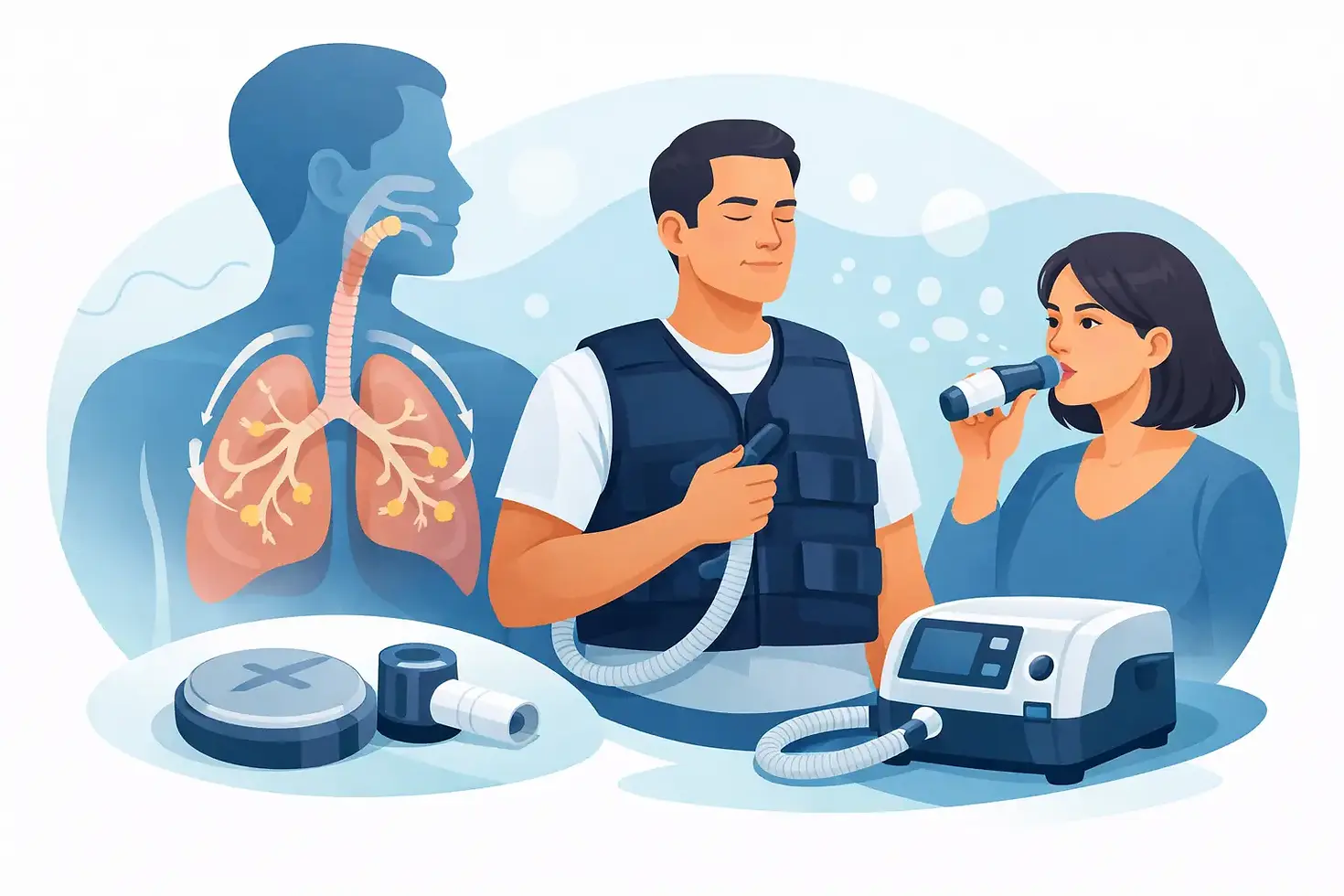
Oscillating positive expiratory pressure devices are another option. These devices create resistance and vibration as a person exhales, which can help loosen mucus and move it toward the larger airways. Many adults like them because they are relatively simple to use and can fit into a home routine without taking up much space.
High-frequency chest wall oscillation systems, sometimes called airway clearance vests, use rapid pulses of air to gently shake the chest wall and help mobilize mucus. These systems can be especially helpful for adults who need regular airway clearance but have difficulty performing manual techniques effectively. They can reduce the physical strain of trying to clear secretions with repeated coughing alone.
Mechanical insufflation-exsufflation devices may be used when cough strength is too weak to clear secretions well. These devices help simulate a stronger cough by delivering positive pressure followed by a rapid shift in pressure. For adults with neuromuscular weakness, this can be an important part of respiratory support.
Nebulized therapies are sometimes used alongside airway clearance, not as a replacement for it. Depending on the care plan, inhaled medications or saline may help open the airways or make mucus easier to mobilize before a clearance session. Timing matters. Many adults get better results when bronchodilators or nebulized treatments are used before their airway clearance routine rather than after.
Why the right technique matters more than the newest equipment
A device only helps if it is tolerated, used correctly, and matched to the patient. That sounds simple, but in real life it is where many people get stuck. One adult may prefer a short routine they can manage independently. Another may need a system that conserves energy because fatigue is a major barrier. Someone with shoulder pain or arthritis may struggle with handheld devices, while another person may find a vest system uncomfortable at first but worth it once they build a routine.
There are trade-offs with every method. Some techniques are low cost and portable but require more effort. Some equipment provides more support but takes more setup time. Some adults want the most independent option possible, while others need something a caregiver can help manage safely.
That is why training and follow-through matter. Good airway clearance is not just about receiving equipment. It is about understanding when to use it, how long sessions should last, what productive coughing feels like, and when symptoms suggest the current plan is no longer enough.
Building a routine at home
Home use is where airway clearance either becomes helpful or gets abandoned. The adults who do best are often the ones whose routine is realistic. A complicated schedule may look ideal on paper and still fail if it does not fit around meals, medications, rest, and the normal rhythm of the household.
Many people benefit from doing airway clearance at the same times each day, often when congestion is worst. Morning sessions can help clear overnight mucus, while an evening session may reduce coughing fits later in the night. Hydration also matters because mucus that is too thick is harder to move, even with the right equipment.
Positioning, pacing, and energy conservation all make a difference. If a person is exhausted after a session, the plan may need adjusting. If coughing is harsh but unproductive, the technique may need to be reviewed. It is common for routines to need fine-tuning over time, especially after an illness or change in lung function.
For families, the goal is not perfection. The goal is consistency and safety. A dependable local respiratory provider can help patients and caregivers understand the setup, maintenance, and everyday use of home equipment in a way that feels manageable rather than overwhelming.
When to ask for help
Airway clearance should make it easier to move mucus, not leave someone feeling discouraged and unsure. If secretions become thicker, darker, or harder to clear, if coughing suddenly increases, or if shortness of breath is getting worse, it is time to check in with a clinician. The same is true if a device is uncomfortable, confusing to use, or clearly not helping.
Sometimes the issue is technique. Sometimes it is a sign that the respiratory condition itself has changed. Adults who use oxygen, non-invasive ventilation, or other home respiratory support may need their airway clearance plan coordinated with those therapies so everything works together more effectively.
This is also where local support can matter. A company like Transcend Medical can help bridge the gap between a prescription and real home use by making sure patients and caregivers understand how equipment fits into everyday breathing care, not just how it works in theory.
Comfort, dignity, and everyday breathing
Chest congestion has a way of shrinking a person’s world. It can make simple things feel harder than they should, from walking to the kitchen to getting through a conversation without coughing. Airway clearance therapy for adults is meant to push back against that pattern by helping the lungs clear what they cannot manage alone.
The right plan does not have to look dramatic to be meaningful. Sometimes the biggest win is a less frantic morning, a more restful night, or enough breathing comfort to stay active at home. When therapy supports comfort and independence in those small but important ways, it is doing exactly what it should.


Comments